


Celebrating 30 years of UNESCO heritage on the Canal du Midi
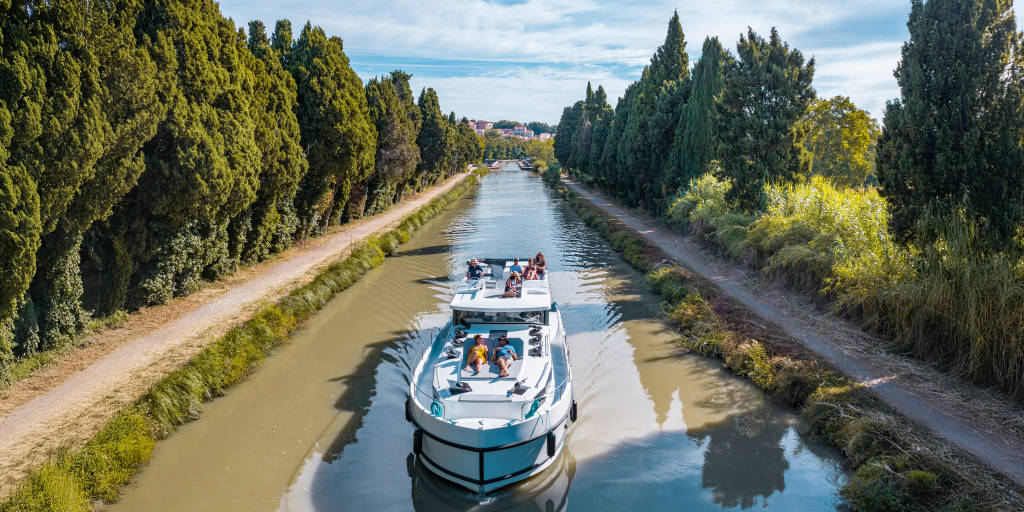
Among the waterways that thread through the Languedoc in southern France, the Canal du Midi is widely regarded as a true jewel; its banks are lined with sunlit paths and filled with centuries of fascinating history and remarkable feats of engineering. In 1996, the Canal du Midi was added to the UNESCO World Heritage list, and in 2026, it will celebrate 30 years of this prestigious recognition. This milestone stands as a testament not only to its historical relevance but also to the extraordinary blend of beauty and ingenuity that defines it.
Through our self-drive boating holidays, we take pride in having played a part in the story of the Canal du Midi, which remains our most popular boating region. Every year, we help people experience just how relaxing, thrilling, and culturally enriching navigating its waters can be. If you’re dreaming of slowing down and savouring the South of France, book your escape today and see the canal from a new perspective.
In today’s article, we’ll revisit some of the key milestones in the history of the Canal du Midi and explore how it continues to inspire us, revealing its remarkable highlights.
Table of contents
Why did the Canal du Midi earn UNESCO status in 1996?
As mentioned earlier, among our canal boating regions in France, the Canal du Midi is the most sought-after. But what makes it so unique to earn a place on the UNESCO World Heritage list? To answer this question, we need to take a step back to the 17th century, when a man named Pierre-Paul Riquet dared to imagine the impossible.

Who designed the Canal du Midi? Pierre-Paul Riquet and the “impossible” engineering feat
Pierre-Paul Riquet wasn’t actually an engineer; he was the King’s tax collector. In the 17th century, France had a bold ambition: to link the Mediterranean Sea with the Atlantic Ocean, while avoiding the waters around Spain, which were then plagued by piracy, storms, and political conflicts. The idea of an inland waterway had existed for centuries, but no one had ever solved the core problem: “where to find enough water to supply a canal running through hilly terrain? Without a consistent water flow, the locks wouldn’t function, the levels would drop, and the canal would fail, hence its reputation as an “impossible project.”
Riquet, however, had a rare combination of practical intelligence, deep knowledge of the French landscape, and sheer persistence. He poured his fortune, energy, and conviction into a plan to capture water from the Montagne Noire and channel it to the canal’s highest point. The result was the Saint-Ferréol reservoir, an extraordinary achievement and the beating heart of the canal. With approval from Louis XIV in 1666, construction began: thousands of labourers, vast earthworks, and hundreds of locks, bridges, and tunnels. The project was completed in 1680, but sadly, Riquet never saw its inauguration, as he died shortly before the Canal du Midi was finished. Today, those same locks and bridges he built still guide boats with surprising smoothness, letting travellers experience his ingenuity firsthand.
The UNESCO designation and the canal’s ‘Outstanding Universal Value’
When the Canal du Midi was added to the UNESCO World Heritage list in 1996, it became one of France’s most celebrated cultural landscapes. UNESCO recognised the canal as an extraordinary feat of engineering, a project that brought together innovation and natural beauty.

The UNESCO designation was based on several Outstanding Universal Value criteria, but in simple terms, the canal earned its place for four main reasons:
- Human ingenuity: it’s a pioneering achievement in hydraulic engineering.
- Exceptional creativity: it’s a brilliant solution to some of France’s toughest geographic challenges.
- Technical innovations: its model influenced subsequent waterways across Europe.
- Living cultural landscape: it’s a place where heritage, nature, and everyday life coexist.
And all of this is undeniably true. Walking along the Canal du Midi today, you come across countless wonders, from characteristic stone bridges to historic locks and quaint villages perfectly integrated with the canal itself. The sense of harmony, enhanced by vineyards that slope gently downwards and quiet mornings filled only with the sound of cicadas, is why travellers, writers, and artists of every kind keep returning.
How to safeguard the Canal du Midi for the next 30 years

Protecting this iconic waterway is just as important as celebrating it. By looking after the canal, we ensure it continues to thrive, safeguarding its wildlife, its history, and the joy of exploring it slowly.
The principal ways the Canal du Midi is being preserved include:
- Replant the canal with various species.
- Maintaining and reinforcing historic locks, bridges, and banks.
- Encouraging slow, responsible travel.
Replanting the plane trees: a living legacy
In recent years, the canal’s iconic plane trees have faced a devastating threat: canker stain, a fungal disease that creates dark streaks in the wood, leads to branch dieback, and can ultimately kill the tree. Thousands of trees have been affected, altering the landscape that so many travellers from around the world have come to know and love. To counter this, a long-term replanting programme is underway, introducing a mix of resilient species selected to restore the historic avenues bring back the shade and beauty of the canal, and create a living legacy for generations to enjoy.
Protecting heritage: locks, bridges, and banks

Safeguarding the canal goes far beyond the trees. Conservation teams work tirelessly to:
- Maintain and reinforce locks, bridges, aqueducts, and banks, keeping these centuries-old structures safe and functional.
- Apply modern engineering solutions to respect the historic character while adapting to today’s environmental challenges.
- Manage water levels and protect biodiversity, with every intervention designed to honour the canal’s unique identity.
- Together, these efforts ensure that people can continue to experience the Canal du Midi as it has been enjoyed for centuries.
How are slow travel, responsible cruising, and self-drive boating protecting the canal?
Not everyone knows that ‘slow travel’ and responsible cruising encourage respect for the structures, waterways, and local communities. As canal boating holiday experts, we know our waterways inside out and are aware that exploring the Canal du Midi at a gentle pace has a real impact on its long-term health. Slow, self-drive boating puts less pressure on banks, wildlife, and the delicate water ecosystem. This allows boaters to enjoy their boating experience while keeping their footprint on the canal to a minimum.
At Emerald Star, sustainability is part of every journey we craft, from mindful navigation to guiding boaters on how to travel lightly, whether they’re new to boating or experts. Every self-drive boating holiday helps protect the canal, showing how adventure and stewardship can go hand in hand.
30 reasons to celebrate the Canal du Midi
We want to celebrate 30 years as a UNESCO World Heritage site with 30 special places and experiences that capture the true spirit of the Canal du Midi. Each one shows why this canal remains one of France’s most remarkable waterways. And the best part? Every stop can be explored on a licence-free Emerald Star boating holiday!
Major cities, towns, and architectural wonders
1 – Bassin de Saint-Ferréol
Celebrate Pierre-Paul Riquet’s ingenuity at this vast reservoir that powers the entire canal system. A masterpiece of seventeenth-century engineering.
Emerald Star stop/experience: make a stop at Port-Lauragais and venture inland by taxi or bike to see the dam and Riquet’s museum.
2 – Seuil de Naurouze (summit point)
Discover the Seuil de Naurouze, the symbolic ‘meeting of the waters,’ where waters flow to both the Atlantic and Mediterranean, and Riquet’s obelisk stands.
Emerald Star stop/experience: moor at the summit and wander along the shaded Rigole de la Plaine feeder canal.
3 – Tunnel du Malpas
Step into history at the world’s first navigable canal tunnel, a 173 m passage cut through solid limestone and quicksand in an 8-day sprint by Riquet’s men!
Emerald Star stop/experience: travel through the dark, historic tunnel near Colombiers or Capestang.
4 – La Cité de Carcassonne

Marvel at the grandeur of this colossal, double-walled medieval fortress that dominates the landscape and stands as a UNESCO World Heritage site.
Emerald Star stop/experience: moor at the port de Carcassonne and walk 30 minutes or take a short shuttle to the Cité.
5 – Fonseranes Locks (nine locks)
Admire this impressive engineering work of seven lock chambers descending a 21.5-meter slope, an incredible masterpiece of staircase locks.
Emerald Star stop/experience: moor at the top or bottom near Béziers, and watch boats pass.
6 – Pont-Canal de l’Orb (Orb aqueduct)
Experience the elegance of the long aqueduct that carries the canal over the Orb river, built later to avoid dangerous river crossings.
Emerald Star stop/experience: cruise high above the river as you approach Béziers.
7 – Écluse Ronde d’Agde (round lock)

Journey through this unique circular, three-gate lock made from volcanic rock, connecting the sea, the canal, and the Hérault river.
Emerald Star stop/experience: pass through the round lock at Agde also called “la perle noire” and moor to explore the town.
8 – Hameau du Somail

Step back in time at this perfectly preserved seventeenth-century coaching inn, a traditional stop for old mail barges.
Emerald Star stop/experience: moor at the quai in Le Somail to visit the rare-book shop and historic stone bridge.
9 – Pont-Canal du Répudre (Répudre Aqueduct)
See the oldest aqueducts and the very first major canal bridge built by Riquet, a testament to his original vision.
Emerald Star stop/experience: stop at charming Paraza village and walk to view the historic stone aqueduct structure.
10 – Toulouse “la Ville rose”, the capital of Occitania
Discover the vibrant western starting point of the canal, famed for its pink brick architecture and the basilique Saint-Sernin. From here, the Canal des 2 Mers links the Mediterranean to the Atlantic, with the Canal de Garonne extending the route to Bordeaux.
Emerald Star stop/experience: book a return trip from Castelnaudary to explore the city centre.
11 – Béziers Old Town and Cathedral

Visit Pierre-Paul Riquet’s birthplace, a charming town featuring winding streets and the imposing Cathédrale Saint-Nazaire.
Emerald Star stop/experience: moor near Fonseranes Locks and take local transport up to the hilltop centre of Béziers.
12 – Canal de Brienne
Connect with Toulouse’s River life via this short final canal segment linking the Canal du Midi to the Garonne (Warning: Emerald Star boats are prohibited on this section of the canal.)
Emerald Star stop/experience: pause at Port Saint-Sauveur and follow the Brienne Canal on foot, passing beneath Toulouse’s bridges as you take in the atmosphere.
Villages, vineyards, and wine estates

13 – Château de Ventenac-en-Minervois
Celebrate the renowned Languedoc wine culture at this stunning château housing the local wine cooperative right on the canal bank.
Emerald Star stop/experience: moor at Ventenac-en-Minervois and sample local Minervois wines in the atmospheric cellar.
14 – Oppidum d’Ensérune
Take in panoramic views of ancient circular, sunburnt fields of the drained Étang de Montady from this fortified settlement.
Emerald Star stop/experience: stop near Colombiers and take a short detour to the viewpoint.
15 – Minerve
Immerse yourself in this spectacularly perched Cathar village and capital of the Minervois wine appellation.
Emerald Star stop/experience: take a taxi from our Emerald Star base in Homps or Argens-Minervois to see the gorges and nearby towns.
16 – Château de Pennautier
Step into the grandest castle on the canal and a major wine estate, known as “Little Versailles of Languedoc”. This seventeenth-century estate near Carcassonne features classical French architecture and was built from 1620 by Bernard Rech de Pennautier.
Emerald Star stop/experience: take a short drive from Carcassonne (Trèbes) base to tour the château and taste Cabardès wines.
17 – Maison des Vins du Minervois
Delve into Languedoc’s wine culture at this central tasting and information centre, the biggest in the region.
Emerald Star stop/experience: take a short walk from Homps port for a tasting of over 140 regional wines.
18 – Château de Paraza
Explore Riquet’s elegant home on the canal; it was his residence during the construction of the nearby Répudre Aqueduct.
Emerald Star stop/experience: stop at Paraza to tour the winery and admire the historic stone facade.
19 – Bram
Wander through a classic village “en circulade”, with narrow streets radiating from the fourteenth-century castle and a charming atmosphere perfect for exploring.
Emerald Star stop/experience: moor at the quai to explore medieval streets and castle ruins.
20 – Capestang
Explore a village dominated by the unfinished 14th-century Collegiate Church of Saint-Étienne and its narrow canal bridge, home to one of the lowest stone bridges on the Canal.
Emerald Star stop/experience: moor at Capestang port to discover the village and its remarkable architecture.
Gastronomy, local specialities, and experiences

21 – Grand Bassin, Castelnaudary
While visiting the Grand Bassin, the largest man-made basin between Toulouse and Sète, stop in Castelnaudary, the culinary capital of the canal. Here, savour its famous slow-cooked cassoulet.
Emerald Star stop/experience: dock at Castelnaudary port and enjoy a dinner featuring the authentic cassoulet de Castelnaudary.
22 – Narbonne and Canal de la Robine
Visit this historic port Roman city, complete with a grand cathedral and ancient ruins, via a small branch canal (Robine).
Emerald Star stop/experience: Moor at Narbonne on the Canal de la Robine for a day of urban exploration and markets.
23 – Ouvrages du Libron
Admire an extraordinary, innovative flood-control mobile system of tunnels and guiding rails, protecting the canal from the flash floods of the Libron River.
Emerald Star stop/experience: pass by this unique engineering structure near our Emerald Star Port-Cassafières base or Vias.
24 – Lauragais Plain
Glide through this vast, fertile agricultural region, historically known for wheat and pastel (woad) cultivation.
Emerald Star stop/experience: travel past the peaceful bief (pound) with views of sunflowers, wheat fields, and the Pyrenees on the horizon.
25 – Épanchoir de l’Argent Double
See Vauban’s historic masonry spillway, designed to safely divert floodwaters from the Argent Double River.
Emerald Star stop/experience: cruise past this impressive engineering marvel near La Redorte.
26 – Saint-Roch Lock, Castelnaudary
Journey through this seventeenth-century lock, framed by gentle scenery and waterside paths. Still today, it remains an important piece of the canal’s engineering heritage.
Emerald Star stop/experience: glide through Saint-Roch Lock and enjoy a leisurely walk along the towpath to take in the surrounding views.
27 – Pointe des Onglous
Reach the final seaward point of the Canal du Midi, where it meets the saltwater Étang de Thau, marked by a lighthouse.
Emerald Star stop/experience: capture an unforgettable photo as you transit into the vast Étang de Thau toward Sète.
28 – Portiragnes
Relax in this quiet, welcoming canal-side village, a peaceful mooring away from larger towns.
Emerald Star stop/experience: spend an overnight stay at Portiragnes moorings and enjoy a local meal.
29 – Château de Lastours
Visit the dramatic ruins of four ancient castles perched on a rocky hill.
Emerald Star stop/experience: take a taxi from Carcassonne for a day trip to the castles and sweeping scenery.
30 – Puichéric Lock
Navigate through this picturesque lock bordered by vineyards and peaceful countryside, a tranquil stretch that reflects the authentic beauty of the Aude region.
Emerald Star stop/experience: pass through Puichéric Lock and stop nearby to explore the village, enjoy local wine tastings and savour the calm along the water’s edge.
Mark the Canal du Midi’s 30th UNESCO anniversary with Emerald Star!
Despite being four centuries old, the Canal du Midi remains as magical as ever, with its locks, sunlit towpaths, and countless hidden gems to discover. No wonder it has been a UNESCO World Heritage site for 30 years, and here’s to many more to come!
Planning to see the Canal du Midi from a new perspective in 2026? Join us in celebrating its 30th UNESCO anniversary with a licence-free, self-drive boating holiday on the canal.
Other articles

Our 4-day cruise on the Canal du Midi
Guide of the wines to discover along the Canal du Midi
